
.png)


To modern-day whiskey enthusiasts, Cabin Still is a brand relegated to the very bottom shelf. Today, it’s a “bourbon with natural flavors,” which means that additives, usually sugar, have been mixed into the spirit to make it more palatable for those who don’t really want to drink whiskey. However, the bright orange Cabin Still label was once an esteemed, high-quality bourbon produced by arguably the most legendary distillery in the USA, Stitzel-Weller. So how did this once highly praised and storied brand, which traces its origins to THE William Larue Weller, find itself in such a dire state? Let’s take a look through its history and see if we can answer that question.

Cabin Still was one of the original brands established by William Larue Weller as part of his liquor wholesale business. Pappy Van Winkle had started as a salesman for Weller in 1893, and a decade after Weller’s death in 1899, Pappy purchased W.L. Weller & Sons. William’s son, George, served as president until prohibition, when their Weller business merged with Arthur Stitzel of the Stitzel distillery. This firm was one of the few to receive medicinal licenses to bottle whiskey throughout Prohibition, allowing them to acquire barrels from other closing distilleries and bottle them under their own brands. Cabin Still was, therefore, bottled throughout Prohibition, utilizing liquid from any distillery the firm could obtain. Some notable sources from which A.PH. Stitzel bottled barrels include the Davies County Distillery, Dowling Bros., and their own distilled stocks.

Once Prohibition was repealed in 1933, the William Larue Weller & Stitzel-Weller partnership acted quickly, building a new distillery in Shively in 1935. Opened on Derby Day, the new Stitzel-Weller distillery crafted a wheat recipe bourbon inspired by the original William Larue Weller. Pappy spearheaded this post-Prohibition revival, bringing Stitzel-Weller under his ownership and cementing the legacy between the Van Winkles and the Shively site. The firm was in an excellent position after repeal, acquiring a solid war chest of funds through their medicinal whiskey bottling practices. While new firms getting into the whiskey business after Prohibition, like the Shapira brothers of Heaven Hill, would have to wait for their distillate to mature, Stitzel-Weller was able to use their stockpiled barrels to bridge the gap until their whiskey was ready. Old Fitzgerald was launched in 1936 using these hoarded barrels, with the first distillate from Stitzel-Weller appearing in 1939.

Old Fitzgerald became the primary brand of Stitzel-Weller in the post-Prohibition phase. Since they only produced a single mashbill and bottled everything in bond at 100 proof or higher, the only differentiation between brands was their age statement. Cabin Still became the younger brother, often bottled around 4-8 years of age, while Old Fitzgerald was much older, with some expressions reaching as high as 12 years.

The quality of both brands was still extremely high, with Pappy’s famous quote, “We make fine bourbon at a profit if we can, at a loss if we must, but always fine bourbon,” guiding the firm. Despite being younger, Cabin Still was always highly praised and marketed as the “sportsman’s choice,” positioning it as a bourbon that a fine Louisville gentleman might sip from a hip flask. However, after Pappy’s death in 1965, Stitzel-Weller would struggle to stay afloat.

The bourbon market was already seeing a downturn heading into the 1960s, and Pappy had fought all his life to bottle only the best bourbon possible, no matter the cost. Julian Jr. had spent years fighting with Pappy to launch an 86.8 proof bourbon to compete with the other lower strength bottlings on the market, but Pappy never conceded. But just a week after Pappy retired in 1964 his son launched Old Fitzgerald Prime, an 86.8-proof offering, the first under-100-proof Stitzel-Weller product. This move couldn't save the Louisville distillery unfortunately as the market had massively shifted, with consumers now preferencing lighter and sweeter styles of spirits. This was at odds with the bourbon Pappy was committed to making, one of darker, heavy and rich flavours. Pappy died in 1965, leaving Julian II in charge but after seven years of struggling the Van Winkle family sold the firm to the large drinks conglomerate Norton Simon in 1972.

To put it politely, Cabin Still was butchered in this transaction. Prior to 1972, the brand was, albeit younger, a fundamentally Stitzel-Weller-produced product. But when Norton Simon came along, they brought sizable stocks of bourbon from a prior distillery they owned, which was ultimately of very poor quality. This is where our story introduces the E.J. Curley & Boone Knoll distilleries, later known as the Kentucky River Distillery.

Boone Knoll was the second distillery built by Edward J. Curley at Camp Nelson. His original E.J. Curley distillery was proving too small for the demand he had built for his exceptional Blue Grass-branded whiskey. Boone Knoll Distillery was built on the opposite side of the Kentucky River to help increase production. The two essentially operated together as one distillery in Fort Nelson. Unfortunately, Curley couldn’t survive, and after failing to pay his taxes, he eventually sold his operations to The Whiskey Trust, a firm with questionable intentions of monopolizing distillation in the USA. The Trust would later become American Medicinal Spirits Co. (AMS), which was granted a license to bottle whiskey during Prohibition. The Trust continued to operate Curley’s distilleries and bottled their stocks through Prohibition.

During prohibition the two distilleries had been converted into holiday resorts, but as repeal loomed they were converted back to functional distilleries. This combination became known as the Kentucky River Distillery and was owned by the Hawkins family. In the late 1950s, the firm behind the hugely popular Canada Dry ginger ale acquired KRD. Canada Dry had become an exceptionally popular mixer during Prohibition as it was used to mask the taste of poor-quality homemade liquors, so the drinks company wanted to move further into the production of spirits themselves. The drinks conglomerate Norton Simon had the same goals, and in 1964, they acquired a stake in Canada Dry Corporation, fully merging to create Norton Simon Inc. in 1968.
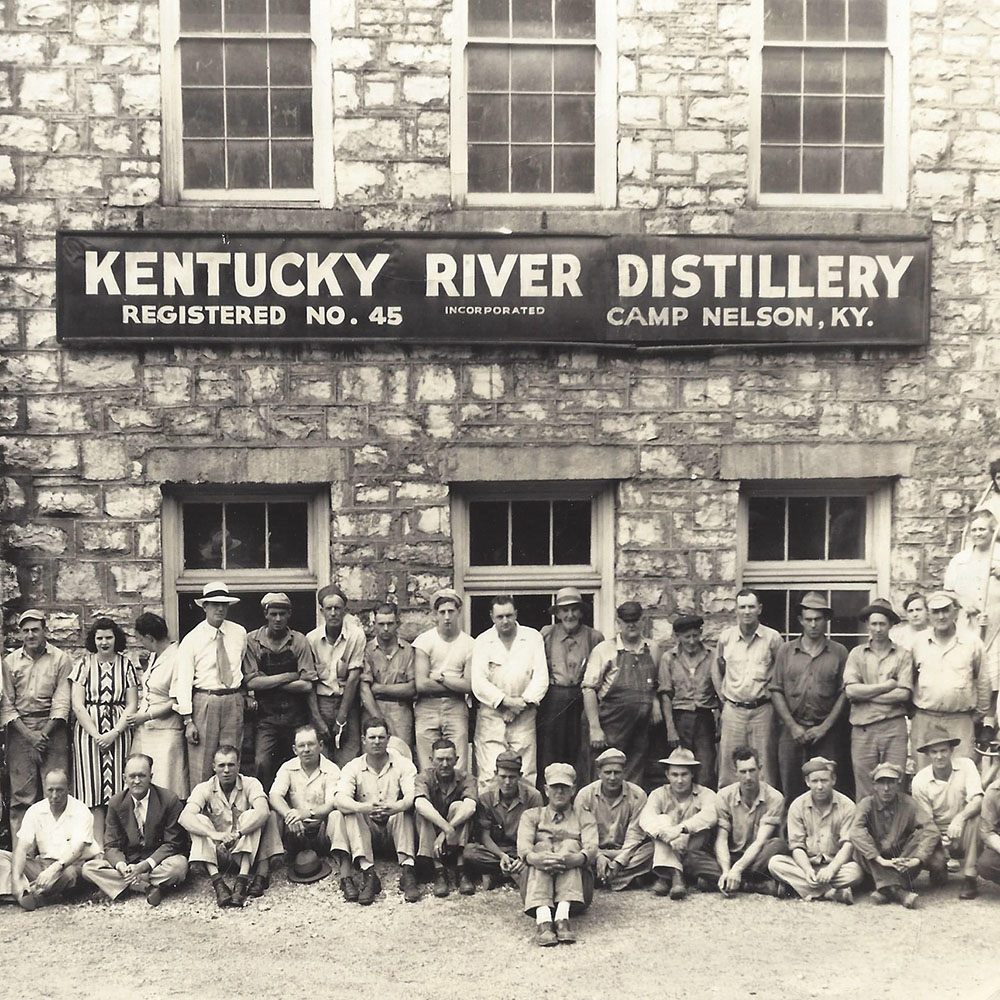
Norton Simon commissioned a large amount of bourbon from KRD for the Canada Dry bourbon, but the quality was awful. Bottled as a 6-year bourbon at 86 proof, it was a rye-grain recipe bourbon, and according to an ex-worker from the site, the spirit had an awful musty profile, reportedly due to an issue with the warehousing of barrels. After just four years of using this spirit, Norton Simon recognized it needed to close the Kentucky River Distillery. The quality was simply nowhere near what the firm had set out to achieve.

Luckily for Norton Simon Inc. and unfortunately for the Van Winkles, the Stitzel-Weller distillery was at breaking point and ripe for acquisition. In 1972, the shareholders of Stitzel, many of whom were Pappy’s children, voted to approve the sale of the distillery to Somerset, the distillation and import subsidiary of Norton Simon. Much to the dismay of Julian Jr., the conglomerate rapidly cut costs in everything from production to bottling practices. They modified the mashbill and, most notably, switched to dried packet yeast instead of fresh jug yeast. This is ultimately why Pappy-era bottlings of Stitzel-Weller are so coveted.

Through this rapid commercialization, Cabin Still’s reputation was demolished. Norton Simon had huge stocks of poor-quality KRD whiskey and needed a place to offload it. They closed the KRD site, electing to focus their efforts at Stitzel-Weller. To capitalize on their purchase, they decided Cabin Still would be the perfect brand to dump these barrels into. Based on reviews of early 1970s bottlings, which note the spirit quality as being passable, it can be suggested that Norton Simon was likely blending subpar Canada Dry spirit with wheated Stitzel bourbon. As the years went by the firm began dumping more and more of the Canada Dry bourbon in, with reviews of the 1980s era bottles noting a marked decline in quality from the early 70s releases. It is unclear when the KRD spirit was entirely used up, but the distillery ceased production in 1972 and the label was still in Stitzel's hands until 1992. Late 1980s and early 1990s bottling have a particularly poor reputation, so there are a few potential explanations.
- KRD spirit was blended with Stitzel-Weller distillate throughout the brand's life in varying volumes, thus the quality of the label varied from year to year.
- KRD liquid was left to mature and so late 80s-90s bottles contain 15-20 year old bourbon. Despite the potential age, the spirit was so poor it couldn't be improved.
- KRD spirit was tanked at a young age and this is why the label was so poor, even 20 years after the distillery closed.
- Sourced barrels from other distilleries were used.
Based on the limited data available we'll never truly know, but from the reviews and anecdotal stories I heard when researching the brand, I believe the label likely went through phases. Originally blending Stitzel & Canada Dry in the early 70s to start transitioning the brand to a new flavour profile. And then in the 70s/80s more KRD spirit was used and only minimal Stitzel. For 80s into early 90s bottles I am conflicted about what spirit may actually be in the bottle, as the reviews for this era note dank cardboard and suggest a bland spirit more like KRD than Stitzel spirit. It is likely still heavy amounts of KRD spirit that, even after 15+ years of age is just bland, dusty and bleak in flavour.

In 1984, the Distillers Company Limited (DCL), the company now known as Diageo, acquired Somerset from Norton Simon and assumed control of all their distilling interests. This meant DCL was now in charge of Stitzel-Weller and all of its brands. The firm showed interest in expanding bourbon operations, but as they acquired more distilleries in the late 1980s and early 1990s, it was decided DCL would divest their interests in the bourbon market. In 1992, it ceased distillation at Stitzel-Weller, instead concentrating all production at the Bernheim distillery, and began selling off its brands. I.W. Harper became their new flagship whiskey, and their other brands were sold to producers like Heaven Hill. Cabin Still was reportedly sold to David Sherman, later named Luxco, but was contract-produced at Heaven Hill. This held until recent years when Cabin Still emerged as a “bourbon whiskey with natural flavors,” which likely means it has had additives, namely sugar, mixed with the spirit. By all accounts, modern Cabin Still is now the ultimate bottom-shelf bottle.

Despite being closed, the legacy of the E.J. Curley distillery, Boone Knoll, and its Kentucky River Distillery history live on in the most unlikely of ways. Conveniently, just as Norton Simon purchased Stitzel-Weller, the KRD stillhouse burned down. The warehouses were left intact, but many are rightly suspicious of the blaze’s timing. The existing warehouses were used by Seagrams to store their Four Roses bourbon and were eventually purchased by Wild Turkey. These are the signature Fort Nelson warehouses that Wild Turkey enthusiasts believe contain the best barrels. A somewhat ironic result, as, to reference earlier, it was noted that Canada Dry bourbon was so awful due to a warehousing issue. Perhaps they solved the issue, or more likely, the raw spirit from their stills was just plain awful.

Cabin Still is just one of many brands in the liquor industry to suffer a fall from grace. Once a valued and respected bourbon from a distillery committed to quality, it is now priced at $8 a bottle and flavored with additives. A desire to dump poor-quality spirits ultimately killed a label started by someone as legendary as William Larue Weller and nurtured by Pappy Van Winkle himself. Luckily, there are still bottles of original Cabin Still to be found, with the brand occasionally popping up at auction. We even hold an original Blue Grass whiskey from pre-Prohibition, distilled at the first E.J. Curley site when it was held in the highest regard. So keep an eye out for those pre-‘72 Stitzel Cabin Stills, as the legacy of Pappy-era wheated bourbon lives on through them.
Cabin Still Brand Timeline
1860s: Curley/Blue Grass distillery built
1880: Boone's Knoll distillery built
1889: Curley sells both Blue Grass & Boone's Knoll to The Whiskey Trust
1890s: William Larue Weller creates the Old Cabin Still label using sourced barrels
1893: Pappy Van Winkle starts working for William Larue Weller
1899: William Larue Weller dies
1908: Pappy buys William Larue Weller & Sons
Early 1920s: Weller & Sons merges with A.PH. Stitzel to survive prohibition
1920: Prohibition enacted shuttering Curley/Boone's Knoll distilleries. A.PH. Stitzel bottles other distillery's products as well its own as medicinal whiskey, surviving the prohibition period. Old Cabin Still is bottled during prohibition
1933: Prohibition is repealed and construction begins on the new Stitzel-Weller distillery in Shively. Blue Grass & Boone's Knoll converted back to distilleries under the new name "Kentucky River Distillery".
1935: On Derby Day the new Stitzel-Weller distillery opens its doors
1936: Old Fitzgerald launched using stored barrels from prohibition
1939: First bottles produced using Stitzel-Weller distilled barrels. Old Fitzgerald is the premium offering and Old Cabin Still is the younger, cheaper label.
Late 1950s: Canada Dry acquires Kentucky River Distillery
1961: Rebel Yell label introduced for Stitzel-Weller
*1964: Norton Simon acquires stake in Canada Dry Corporation
1965: Pappy Van Winkle dies
*1968: Norton Simon & Canada Dry fully merge to create Norton Simon Inc
1972: Norton Simon acquires Stitzel-Weller
1970s: Norton Simon uses the Cabin Still brand for its subpar Canada Dry bourbon. Stitzel spirit rumoured to be blended in early
1980s: Cabin Still expected to be primarily Canada Dry distilled spirit
1984: Distillers Company Limited (now Diageo) acquires Stitzel-Weller
1992: United Distillers (previously Distillers Corporation) shutters Stitzel-Weller
Post 1992: Stitzel-Weller's brands including Cabin Still are sold to Luxrow, Heaven Hill & Sazerac (who now own Buffalo Trace)
Modern day: Cabin Still is now sold as either a young Kentucky bourbon or a whiskey with flavouring by Luxrow or Heaven Hill.
*Dates are highly conflicting for when Norton Simon & Canada Dry merged. With some sources suggesting 1959. Various dates are available but certainly late 50s-late 60s is in line with publicly available documentation.
References & acknowledgments
A huge thanks to Joshua Feldman for his articles & tastings on the Cabin Still brand which inspired the creation of this piece.
Joshua Feldman, JF 2014, The Coopered Tot, 'The Tragedy of Old Cabin Still',
< http://www.cooperedtot.com/2014/04/the-tragedy-of-old-cabin-still.html >
Michael Veach, MV 2021, Bourbon Veach, 'Flashback Friday – Cabin Still ca. 1975'
< https://bourbonveach.com/2021/08/13/flashback-friday-cabin-still-ca-1975/ >
Josh Peters, JP 2015, The Whiskey Jug, '1970s Cabin Still Review'
< https://thewhiskeyjug.com/bourbon-whiskey/1970s-cabin-still-review/ >
Fred Minnick, FM 2016, Whisky Magazine, 'Short History of Stitzel-Weller'
<https://www.whiskymag.com/articles/short-history-of-stitzel-weller/>
Whiskey ID, 'Timelines: Stitzel-Weller'
<https://whiskeyid.com/stitzel-weller-timeline/>
Michael Veach, MV 2019, Bourbon Veach, 'The Legend Of Stitzel-Weller Distillery'
<https://bourbonveach.com/2019/05/06/the-legend-of-stitzel-weller-distillery/>
Jack Sullivan, JS 2015. Pre-Pro Whiskey Men, 'E. J. Curley Turned Boone’s Knoll into a Distilling Marvel'
<http://pre-prowhiskeymen.blogspot.com/2015/01/e-j-curley-turned-boones-knoll-into.html>


.png)


